

5 of the Best... Lisbon


Welcome to Lisbon - the vibrant capital city of Portugal. This colourful and historic city is located at the yawning mouth of the Tejo River, and it's because of this access to the sea, that 'Lisboa' prospered. Explorers like Vasco da Gama and Ferdinand Magallen propelled Portugal's 'Age of Discovery' in the 15th and 16th centuries, whereby they were able to travel around Africa to India, and across the Atlantic Ocean to Brazil. The trade brought riches to Portugal and Lisbon then flourished as a 'melting pot' culture with influence from their colonies. The 1755 earthquake devastated the city, but its reconstruction saw Lisbon bounce back, and today it stands as one of the great European cities. In this article, I've chosen '5 of the Best...' sights to explore in Lisbon, and touch upon significant eras of its history along the way. I hope it's an enjoyable read...
Praça do Comércio
We begin with Lisbon's iconic 'Praça do Comércio' (Commerce Square) - a grand harbourfront plaza. This was the focal point of the Marques de Pombal's redesign of Lisbon, following the destruction of the 1755 earthquake on All Saint's Day. Grandiose arcaded buildings surround three of the four sides of the square, whilst marble steps lead down to the Tejo (also known as the Tagus) River to the south. The local people know it as 'Palace Square', as for over 400 years from 1511, this was the site of the royal palace. The feel of the square today still holds an opulent atmosphere, especially so thanks to the magnificent triumphal 'Arco da Rua Augusta'. This marks the meeting point of the Praça do Comércio and the Rua Augusta - one of Lisbon's most famous thoroughfares that has been pedestrianized since the 1980s. Atop the arch facing Commerce Square, are sculptures which represent Glory crowning Valour and Genius. The words in Latin highlight the resilience of the Portuguese people following the 'quake, as it translates to: "To the virtues of the greatest, so that it may serve as a lesson to all". I like the metaphor of this archway dominating the square and how the statues and words inscribed symbolize the city's rebirth and restoration.
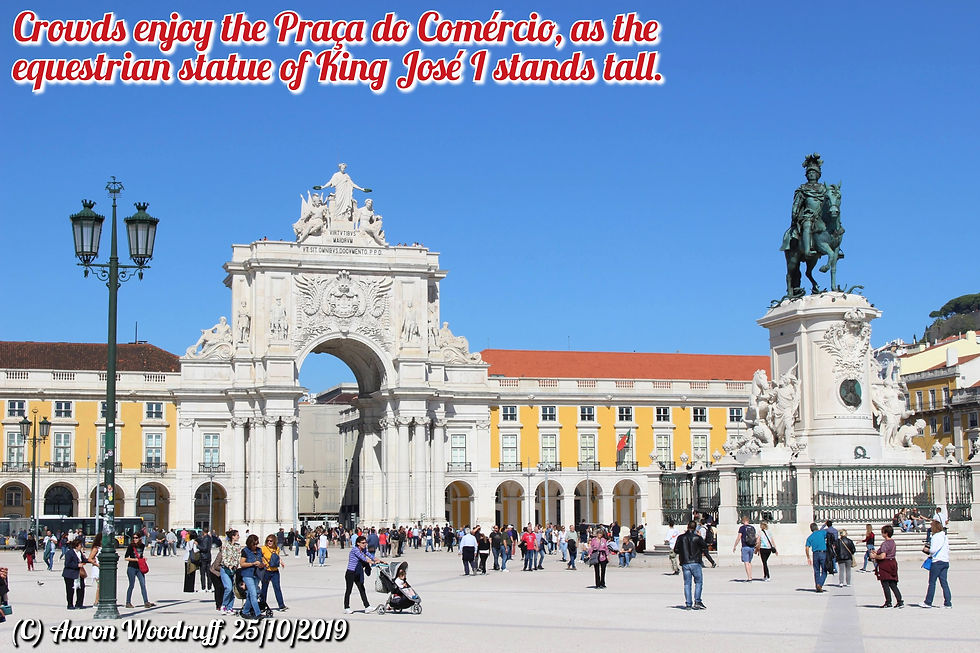

The actual size of the square is impressive and of all the sights in the capital city, provides the real "I'm in Lisbon!" feel to it, as you mingle amongst the crowds! It's approximately 36,000 square metres big, and thus provides a great place to host festivals and cultural events throughout the year - such as featuring a wonderfully illuminated Christmas tree during the festive period. Dominating the centre of the square is a huge bronze statue of King José I, and the steps around it provide a great place to sit for a while and 'people watch' as tourists explore the square! The Praça do Comércio would play a pivotal role in Portugal's early 20th century history as well; King Carlos and his son, Luis Felipe were assassinated as they passed through on the 1st February 1908. This was a highly significant moment in terms of establishing the Portuguese Republic we see today, as the assassinations contributed and ultimately led to the downfall and eventual abolition of the monarchy in 1910. This great square also featured during the 1974 Carnation Revolution, when the Armed Forces Movement removed Marcelo Caetano from power, and in turn brought about to an end the dominance of the Estado Novo regime (a nearly 50 year old dictatorship). Known as the 'Bloodless Revolution' - the Portuguese celebrate 'Dia da Liberdade' (Freedom Day) on the 25th April as a result. This breakthrough saw the Republic transition into a democracy from a dictatorship; the striking red '25 de Abril' Bridge, which can be seen from Praça do Comércio, was renamed as such to honour this. Without a doubt, for both its beautiful aesthetic and pertinent history - the Praça do Comércio is the highlight of the 'Baxia' (the Lower Town) part of Lisbon.

Castelo de São Jorge
Perched high above the Praça do Comércio in the east, is the Moorish citadel of São Jorge (Saint George) Castle. This Portuguese landmark provides one of the best viewpoints in the whole city - providing a wonderful perspective of the red-tiled rooftops of Lisbon below. I love the overview of the city that you attain from up there - it's hard to beat the views of the rooftops basking and reflecting the sun on a bright day! Whilst the Observation Terrace is wonderful, exploring the castle itself makes it well worth the trek up there from the Baxia (taxis are a great option on a hot day!).


The Moors were the Muslims who swept in from North Africa when Tariq Ibn Zayid crossed the Strait of Gibraltar in the year 711, and they controlled much of the Iberian peninsula for many centuries. They established their fortified citadel in Lisbon in the mid 11th century, however as part of the 'Reconquista' (Christian Reconquest) of Iberia - the Moors were pushed back in the 12th century. The Siege of Lisbon saw Afonso Henriques become the first King of Portugal, and in doing so, conquered this castle in 1147. After this, these ramparts encompassed a royal palace for over 300 years, before it was moved to the aforementioned Praça do Comércio in the early 16th century. After this, the citadel was used as a prison and arms depot, and even a theatre, before that 1755 earthquake left much of it in ruins until 1938. Antonia Salazar renovated this historic place, and rebuilt the walls in the 'Medieval' style. So whilst not everything seen at the citadel may be as old as one might think - it's still asgreat place to stroll and imagine the layers of history that took place there. Whilst doing so, you'll enjoy the most awe-inspiring views of Lisbon, and wander amongst the many beautiful Indian peacocks that've roamed the ramparts since the 15th century.

Alfama
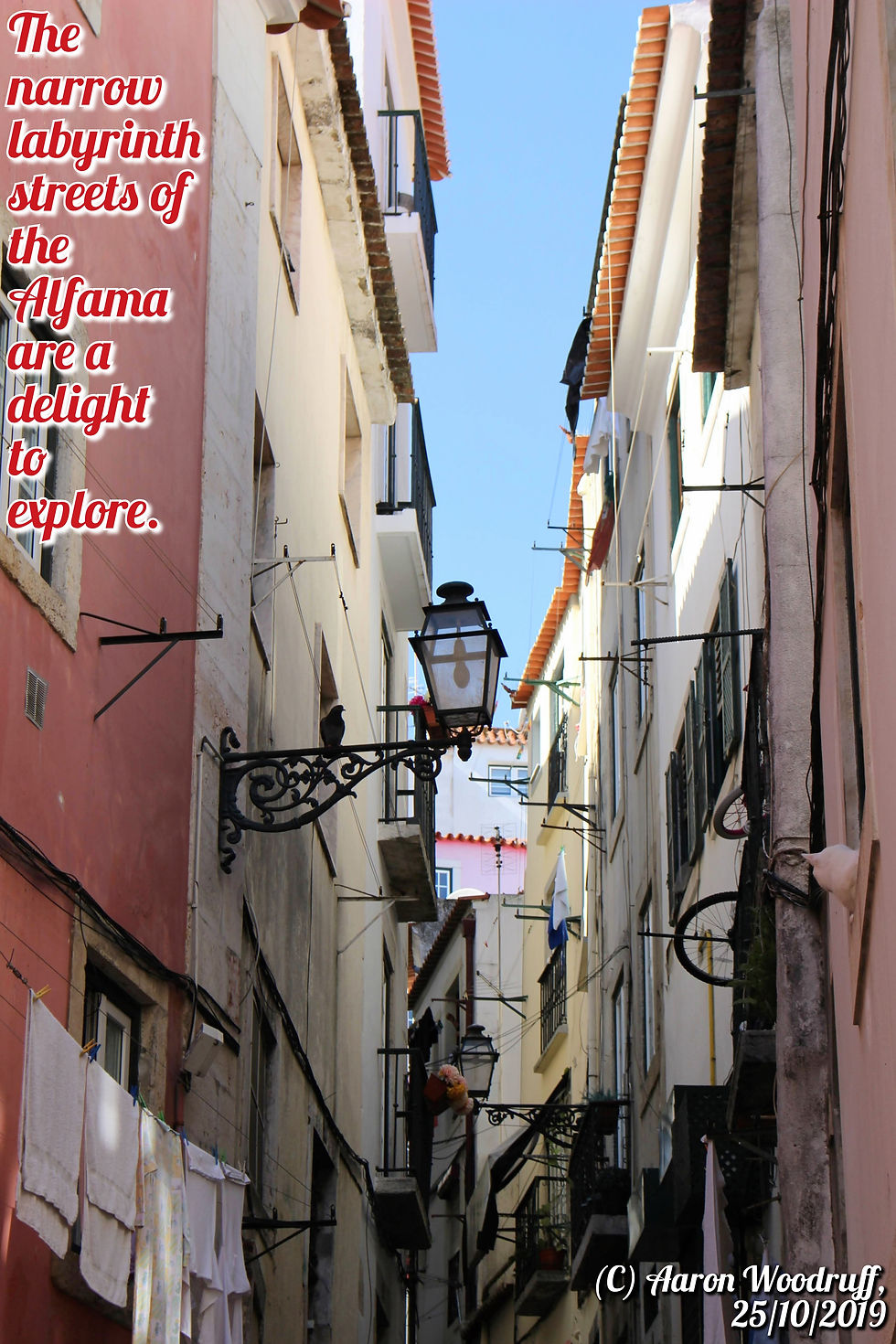
On the way up to and on the way back down from São Jorge Castle, you wander through the cobblestone streets of the Alfama - Lisbon's oldest district. Unlike the neighbouring Baxia, the Alfama largely survived the earthquake of 1755. As a result of this, this hilly district is a ramshackle mix of architecture that evokes tales from times past. Tumbling down the labyrinth like streets, you pass tiny bars, the 'Feira a Ladra' street market (twice-weekly) and 'azulejo' adorned facades (azulejo is the uniquely Portuguese use of tiles - often blue and white, which decorate walls). The Alfama is also the birthplace of 'fado' music - which is a mournful, 'wailing' like style of music. 'Fado' could be described as 'Portuguese blues', after it originated from loved ones missing sailors and people out at sea. The emotion known as 'saudade' is portrayed through fado - which epitomises a sense of nostalgia, yearning and longing for someone or something that one is without. In the Alfama, which is also known as the 'Fisherman's Quarter', you can really feel the past connect with the present - it's a place to simply ramble and appreciate the charm of the streets.


It's in the Alfama that you'll also see the twin castellated towers of the Lisbon Cathedral. Known locally as 'Sé de Lisboa' - this place of worship was established in 1150 following the Christian re-capture from the Moors. On the site of a former mosque, this cathedral was built for the first Bishop of Lisbon. As a Roman Catholic holy place, the architecture is predominantly Romanesque, however it was affected during the tremors in the 14th and 18th centuries, and therefore its re-build sees it now feature nine Gothic styled chapels. After a while exploring the interior of the Sé (short for 'Sede Episcopal' - which means the seat of a bishop), you can capture some 'typically Lisbon' photos a short walk down the hill, by photographing the yellow trams wind their way past in the foreground of the cathedral's front facade. The Sé stands tall to this day and beyond, as a beacon of faith in the Alfama...
Belém's 'Seafaring Story'
Moving west of the city centre from the Alfama in the east - the beautiful Belém district also survived much of the earthquake damage. As a result of this, visiting provides a fascinating insight into Lisbon's seafaring story - which peaked in the 15th and 16th centuries. The 'Torre de Belém' (Belém Tower) stands on the banks of the Tejo River, and would have been a much wished for sight for the sailors returning home - as they once more made it home to Lisbon. The trade in which the 'Age of Discoveries' fuelled, enriched Portugal, and its this wealth which saw the architecture flourish. This trade of the likes of cinnamon, gold, silver, and regrettably, slaves, meant that King Manuel I could build a legacy in stone. His own, uniquely Portuguese architectural style was born - and this would become known as 'Manueline'. This fusion of Gothic, Renaissance and Moorish styles became Manueline - one which also includes maritime iconography and themes (like ships and ropes). It's the tower-fortress of the Belém Tower, built between 1514 and 1520, that best showcases the Manueline style - in tandem historically, with the much adored nearby Jeronimos Monastery.

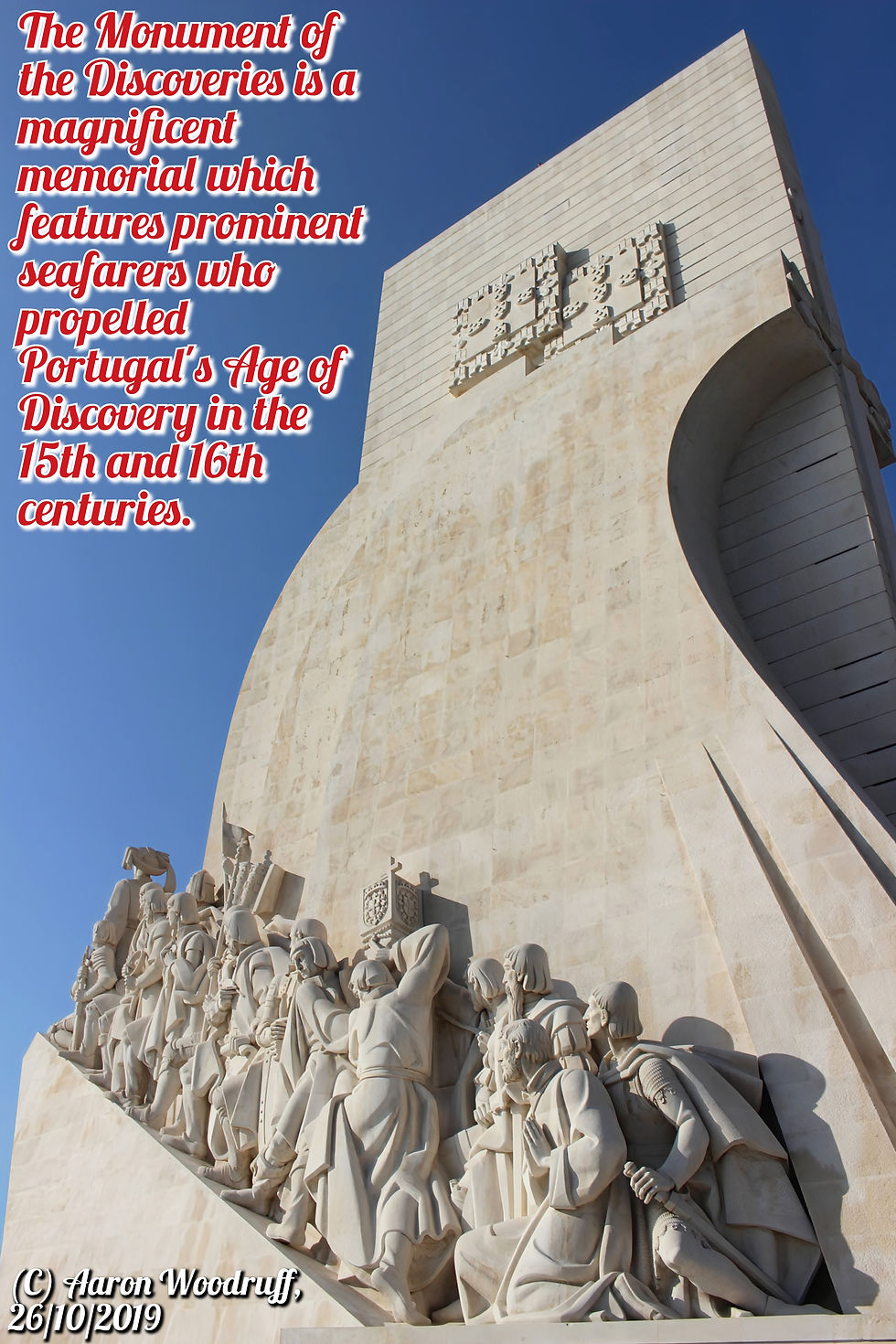
It's inside the 'Mosteiro dos Jeronimos', where you'll find the tomb of legendary navigator, Vasco da Gama. He famously found his way around the Cape of Good Hope at the southern tip of Africa, in order to colonise Asian places. Most famously in his lifetime - was the route he established to India (there's a city called Vasco da Gama in India today). It's fitting that da Gama is laid to rest at Jeronimos, as it was there, that along with many seafarers of the time, he prayed for a safe voyage. Commissioned by Manuel I around 1501, Jeronimos was declared a UNESCO World Heritage Site in 1983. The interior is marvellous - the decorative slender columns are uniquely Manueline. The cloisters at the back of the church are the architectural highlight of the monastic complex; across two floors - the cloisters feature intricate carvings in the stonework and grand vaulted ceilings. Just across the street and back towards the Tejo River, along with the Jeronimos Monastery and the Belém Tower, the Monument to the Discoveries completes a trio of sights symbolizing Lisbon's seafaring story. A modern construction in comparison to the Manueline treasures, the 'Padrão dos Descrobrimentos' was completed in 1960 to commemorate the 500th anniversary of the death of Prince Henry the Navigator. The 52 metre high monument can be visited and scaled to the top, which provides a great 360 degree view of Belém, with a look down at a world map on the floor below. I think this is a marvellous structure which honours all those who were involved in the Portuguese Age of Discovery. I'll never forget my first visit to Belém and being fascinated by the 'seafaring story' of Portugal's history - the monuments linked to this certainly bring that history to life!

Day-trip to Sintra
Just over half an hour away by train from the Rossio Station in the centre of Lisbon - the historic town of Sintra is like a journey into a fairytale. Recognized as a UNESCO Cultural Landscape Site in 1995, Sintra was once a favourite summer retreat for the kings of Portugal. Located in the Sintra-Cascais National Park, the highlights of Sintra are set among lush green forests. In the town centre is the towering twin conical chimneys of the 'Palácio Nacional de Sintra' - an ecclectic mix of Moorish Manueline and Gothic architecture. King João I orchestrated the construction of the main part of the palace in the late 14th century - and it was a place of residence for the Portuguese royalty right up until 1910. The palace is built upon different levels, in synchrony with the natural terrain in which it sits. One of the highlights inside is the 'Swan Room' - featuring a ceiling covered with swan paintings, which came about from when João I was with Philippa of Lancaster. Her brother, Henry IV of England, had used the swans with crowns as an emblem, and thus this symbol was used in the National Palace of Sintra. Interestingly, the Anglo-Portuguese relationship is the oldest formally agreed alliance in the world - thanks to the Treaty of Windsor, signed in 1936.


For some of the best Sintra views and a grand look down upon the National Palace, you can take a shuttle bus up to the Moorish Castle. Dating to the time of Muslim dominance of Iberia, alike the São Jorge Castle in Lisbon - the ramparts there are undulating and rocky. Nearby atop the highest peak of the 'Serra de Sintra' - is the spectacular 'Palácio Nacional da Pena'. This is the whimsical and Romanticist vision of the German born prince, King Ferdinand. He was the cousin of Prince Albert, who married the infamous Queen Victoria - and alike him shared a love for art, nature and the new inventions of the era. This incredible passion for exploring unique new styles, culminated with the completion of the Pena Palace in 1885 - which was on the same year in which he passed away. The bright yellow and red exterior formulates the 'postcard image' of Sintra, and after the Republic of Portugal was established in 1910, this fanciful pleasure palace was thankfully preserved as a museum. Nowadays it still provides a wonderful insight into the extravagance of the royalty in the 19th century. And this, along with the other sights mentioned like the National Palace and Moorish Castle in Sintra, certainly makes it a special day-trip experience from Lisbon - one that is well worth taking the 40 minute train ride from the capital city to see!

Honourable Mentions
Lisbon has so much more to offer than the five sights that I've selected for this article; here's a few more of the 'best of the rest' to consider experiencing when visiting the Portuguese capital city...
*Convento do Carmo: the ruined remains of Carmo Convent stand un-restored from the 1755 earthquake - an evocative site which makes you imagine the devastation of that disaster.
*Elevador de Santa Justa: by the convent, the Santa Justa Elevator resembles the Eiffel Tower in style, as it was built by an apprentice of Gustave Eiffel, called Raoul de Mesnier du Ponsard.
*Oceanário de Lisboa: the city's acclaimed Oceanarium is focused on education and conservation of the many beautiful species of different sea-life that live in our global oceans.
*Cristo Rei: the Monument to Christ has synergies with Rio's famous statue in Brazil, and is located across the Tejo River - but can be viewed overlooking Lisbon from places like the Belém district.
*Pastéis de Nata: the iconic Portuguese custard tarts are a delicious treat to try; they originated in the Antiga Confeitaria in Belém and the recipe has been passed down generations since 1837.

I hope you've enjoyed this journey into the history of Lisbon through a look at some of its best sights. Lisbon left its mark on me so much because its fascinating history simply blew me away... before visiting I had no idea about the famous 'Age of Discoveries' and learning about it when visiting in 2019 and over the years since, has been really enjoyable. Lisbon's seafaring history is the aspect that makes Lisbon so special to me, whilst it's range of other sights to see and experiences to enjoy make it one of Europe's great cities. I'll definitely be back again; muito obrigado, Lisboa!


By Aaron Woodruff
Lessons & Joys of Travel
17/12/2025


Comments