

5 of the Best... Tunisia


Located in the centre of North Africa, Tunisia's only a three hour flight away from London, but is a journey into an exotic culture that feels a way away from Europe. As a Muslim majority country like its neighbouring countries to the south of the Mediterranean Sea, Tunisia's Islamic traditions shape many of its sights and experiences. From Tunis Medina sprawling out from the Zitouna Mosque, to the Great Mosque of Kairouan that’s a historic pilgrimage place - Islam is at the very heart of the nation today. Further back in time, Roman influence can be seen at the many remarkable archaeological sights and museums of Tunisia - with the likes of Dougga being considered one of the best preserved Roman cities in Africa. All of this is bounded by a geographic location that has not only put it at a focal point of historic events, but also shaped a landscape so varied and exciting; from the Sahara Desert to coastal cities, to lush green valleys and winding mountain roads. With memories of my visit to Tunisia this year on a group trip in February, I'm picking out five highlights to write about and share photos from, in '5 of the Best... Tunisia'. Welcome to this journey into the best of Tunisia; I hope it's a fun read...

1. Tunis

We begin in Tunisia's capital, and the place where like many people, my journey began. Tunis is situated to the country's north, and has a handful of sights that provide a great insight into Tunisia's long history. The best place to go in order to fully immerse yourself with a sensory overload, is Tunis Medina. I haven't been anywhere that reminds me as much as the Old City of Jerusalem - as much as this place! The narrow labyrinth streets throng with life - it's a hive of activity with street vendors selling a wide array of goods. From carpets and spices, to handcrafted art and modern fashion, to expensive jewellery and leather goods (slippers, hasouks, jackets and more!) - you can find pretty much everything in Tunis Medina. Simply walking these streets is a great experience - whether you intend on

buying anything or not. The Zitouna Mosque's minaret rises tall from the lovable chaos (this mosque's founding dates to 699 AD), whilst rooftop cafes provide great city views (like the famous and aptly named Cafe Panorama!).
Just to the west of Tunis Medina is the Kasbah Square - a vast marble square crowned by the Monument of the Kasbah and overlooked by the decorative City Hall. In the south of the medina is the best sight to learn about the royal past of Tunisia: the Tourbet El Bey. This is a complex of tombs which houses past 'Beys' of Tunisia (like a Turkish 'Sultan'). In fact, many of those laid to rest here were linked to Türkiye as Tunisia was ruled by the Ottoman Empire for over 300 years (from conquest in the 16th century up until the French occupation of 1881). There's different tombstone heads which have different meanings, and during my visit I remember being given a guided tour by a local cat... it followed me the whole way around! The whole Tunis Medina is dotted with many feline friends, and it's these animals along with the plentiful array of colourful doors of the city, which capture many a keen photographer's attention!


Stretching to the east away from the medina is the Habib Bourguiba Boulevard (our Explore tour guide, Yousra, compared it to Paris's Champs Elyses!). And in the centre of the roundabout at the east of this street, is Tunisia's answer to 'Big Ben', with the Tunis Clock Tower rising tall. There's also an equestrian statue of Habib Bourguiba himself; portrayed by statues around the country, Bourguiba was the first President of Tunisia following independence from the French colonial rule in 1956, whereby he led for 30 years. The other must see sight in Tunis is the Bardo Museum - home to a splendid collection of antiquities that celebrate Tunisia's heritage. The Bardo is a little way out from the city centre, but is well worth it for its stunning mosaics and palace architecture. It’s truly astonishing the amount of mosaics that Tunisia has displayed in various museums across the country - and so many are in great condition to admire.

2. Carthage

Nearby to the Tunisian capital, the ancient ruins of Carthage are undoubtedly a huge draw for lovers of history. There’s been a Phoenician settlement in this area by the coast since the 9th century BC, before it famously became a place of Carthaginian prominence. As the Romans were looking to expand, it led to a face-off between Scipio and Hannibal… in the Roman Republic’s conflict with the Carthaginians - known as the Punic Wars. They had five hundred years of prosperity before the Romans established control of this region of northern Africa in 146 BC. As a result of this, Carthage became a ruined city due to the typically brutal nature of the Roman conquest - however they did also build their own structures whereby some of which have lasted the test of time well. Nevertheless, visitors to Carthage today need to go with a sense of imagination to envisage the peak of Carthage during the Carthaginian Empire (dating back to 884 BC and peaking around 300 BC), and then ultimately the Romans (from just shy of 150 years BC and a while beyond).

The sights of Carthage today are spread out across a vast area - symbolic of the scale of this place during the peak of ancient human activity before Christ. One of my favourite sights seen was the Punic Ports. Whilst there were other more elaborate ruins to see, these ancient ramps are amazing for imagining boats setting sail on the coastline here over 2,000 years ago. Highlight sights to see include the 36,000 capacity amphitheatre, the Roman Villas (with the standout sight being the the ‘Villa of the Aviary’ with a mosaic floor of birds), the long views from Byrsa Hill and of course the Baths of Antonius - the iconic ‘cover image’ of Ancient Carthage (albeit being built after the peak and fall of the Carthaginians themselves to Rome). The Baths of Antonius were started under Emperor Hadrian in the 2nd century AD, but were finished under Emperor Antonius. Interestingly, this was the largest thermae (bath complex) outside of Rome, and the water for it was supplied by the mighty Zaghouan Aqueduct (ruins of this ancient irrigation can be seen near Tunis… it is an architectural feat of engineering in its own right!).

3. Dougga

Continuing the theme of Roman influence in Tunisia, for number three on this ‘5 of the Best… Tunisia’ - I’ve chosen the expansive ruins of Dougga. Reading up prior to visiting Tunisia, I knew I was going to be impressed by Carthage, Tunis and El Jem (which will of course feature in this article), but little did I know how much Dougga would provide such a ‘wow’ factor for our tour group. I’ve been very privileged in my life to have visited some stunning ancient sites showcasing outstanding Roman architecture - like Jerash in Jordan, Caesarea in the Holy Land and Volubilis in Morocco - but lesser known Dougga, was absolutely equally impressive.
This vast complex dates back 4,000 years and is an eclectic mix of Carthaginian, Numidian and Roman construction. The Numidians called it Thugga, and they sided with Pompey during the 48 BC Roman Civil War, but lost to Julius Caesar which led to the site becoming controlled from Rome. When Caesar took control in 46 BC, they called it Dougga. During the expansionist agenda of the Roman Empire (Rome ceased to be the Roman Republic in 27 BC, when it became an empire) - cities like Dougga flourished. This particular site on high land in present day Tunisia, peaked from the 2nd to 4th centuries AD. Naturally with the fall of Rome, the city had a gradual decline but many of the buildings are still in remarkable condition. People, mostly Berber and Arab Muslims, even lived here still until more recent times (the 1950s). Today it’s recognised by UNESCO as a World Heritage Site and is without a doubt a treasure of Tunisia.

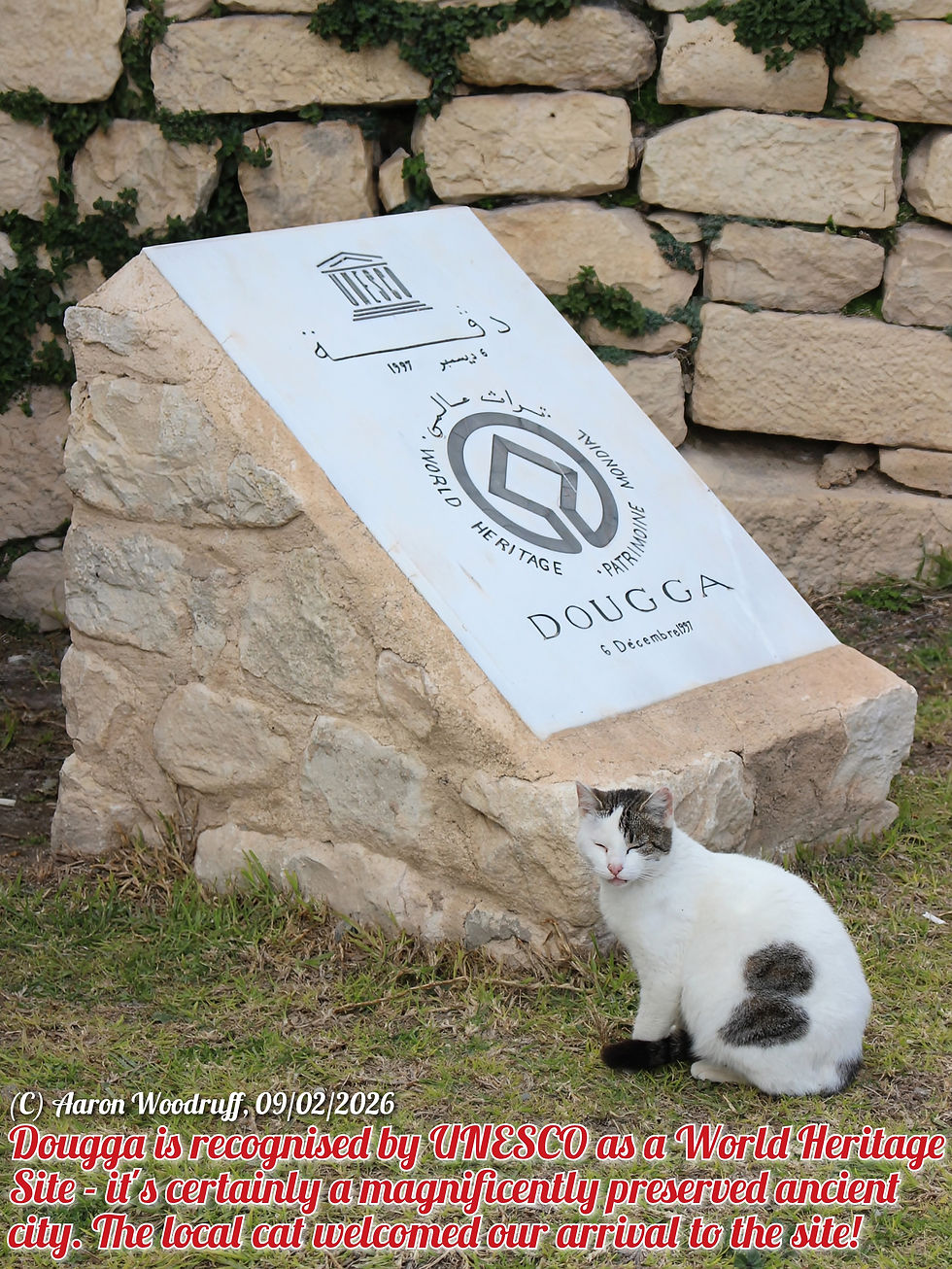
One of the most spectacular buildings to admire at Dougga is the Capitol, which was dedicated to the trinity of Jupiter, Juno and Minerva (MInerva was the Roman word adopted for the Greek deity, Athena). This temple has gleaming Corinthian columns and stands tall over the ruins of Dougga. There is also the impressive Roman Theatre, which was able to hold 3,500 spectators way back in the 2nd century AD. Beyond these two top picks of this archaeological site - there’s so much more. Dougga showcases many of the iconic features of a Roman city: original cobblestone streets, Roman mosaics, triumphal arches, innovative irrigation systems and even the communal latrines (toilets!) that the inhabitants would have used just shy of 2,000 years ago. During our visit, the weather was sunny to start with, however the blustery winds brought dark skies into the area which provided an atmospheric backdrop for photos! Luckily, our tour concluded before the rain really set in, and I left Dougga completely blown away by how fascinating the site was - for somewhere I honestly had not heard of before booking this trip! I love exploring ancient cities - it's an honour to add Dougga.

4. Tozeur

There’s few names that sound quite so exotic than the city of Tozeur in the southwest of Tunisia. Right on the cusp of the vast Sahara Desert - this oasis-like settlement is a highlight of the nation. There’s so much to draw people south to Tozeur… it’s home to unique architecture, stunning landscapes all around, along with an entertaining city centre with some great museums. To the south and east of Tozeur is the expansive and arid Chott el Jerid Salt Flats, whilst nearby is also the Sidi Bouhlel Canyon - an awesome sight which is a great place to go hiking amongst the rocky terrain. This mighty canyon is also popular among fans of Star Wars because it was used in a few of their movies (I haven’t ever gotten into Star Wars - but the canyon’s landscape was incredible to see in its own right!). Many people who are into this famous movie series visit Tunisia to visit locations that were used for filming. Some of my fellow group members visited Mos Espa in the afternoon - another key filming location near Tozeur. During this trip in February, we had two nights in Tozeur, which was nice as it meant we had a full day in the city to explore. There were a few optional activities which could be done to enhance the experience. I opted for one of the two - visiting the aforementioned canyon in the morning, along with seeing how the Tozeur bricks were made and visiting a date plantation. I didn’t do the Star Wars visit in the afternoon, which meant I had some time in Tozeur to visit the Dar Charait Museum back in the city, which was located within walking distance from the hotel.


This was a fascinating museum - showcasing numerous different aspects of Tunisian culture with different artefacts and well laid out displays. The Dar Zamman ‘time-travel’ part of the museum certainly left its mark in my memory! This was a very entertaining journey, right from the dawn of time (yes, with large dinosaurs!) - depicting key events in Tunisia’s through film set like exhibits - complete with Madame Tussauds like figures. There was dramatic and engaging voice overs to the backdrops - providing an immersive and engaging experience for visitors learning about Hannibal crossing the Alps on elephants, the arrival of Islam, and the founding of the modern Tunisian nation - explaining the make up of their Republic (formed in 1957 following the abolishment of their monarchy) run by the President. This museum was a really entertaining afternoon for me in Tozeur. I certainly respected the effort that was put into the displays (it was great for a visual learner like me - sometimes museums can be information overload - but this was a nice balance of the info' and entertainment).

In the evening I met some of the rest of the group for dinner, and then headed out for a walk in central Tozeur after darkness had fallen to do some night photography with the buildings illuminated. The six tiered brick fountain in the centre of Tozeur is a famous landmark and lit up nicely, whilst you could really see the details of the stunning Tozeur bricks which we learnt about earlier in the day. It’s such hard work making the bricks and drying them in the sunlight, so it was eye-opening seeing the dedication put in by such hard-working locals. The Tozeur bricks have become an icon of the city - alike how Bath stone has become a trademark of the city nearby my home in Somerset. These hand crafted yellow-brown bricks have been used to not only build Tozeur - but also create a unique architectural style with the way they are placed in decorative patterns. I was really impressed with how nice the buildings looked by using these bricks - and the next morning exploring the Ouled El Hadef (Old Quarter of Tozuer) only left me more mesmerized by it all. There was also a mural of a man holding dates near the Old Quarter. The previous day at the date plantation, it was interesting learning about their prized export - dates are really great for us! Containing such nourishment and hydration for locals and very popular all around the Maghbreb region of North Africa and the Middle East, they are now renowned globally as somewhat of a 'superfood' and therefore there’s a great revenue to be made from these dates (which grow in their masses in the southerly oasis region around Tozeur). There was so much to learn and see in Tozeur… brilliant!

5. El Jem

Concluding this ‘5 of the Best… Tunisia’ article, brings us to the most stunning ancient site in the country: the spectacular El Jem Amphitheatre. Home to North Africa’s very own ‘Colosseum’ - the town of El Jem (or El Djem) is understandably a focal point for tourists in Tunisia. The five places discussed in this article have been in the order in which I was fortunate to visit during the group trip, and it was nice the way in which anticipation built up towards visiting El Jem. Known as Thysdrus during Roman times, they built the grand amphitheatre in the 3rd century AD, where it went on to become one of the region’s most important settlements. The olive groves around El Jem made it very wealthy. It’s the 4th largest in the Roman world - the Amphitheatre of Thysdrus (El Jem Amphitheatre). This magnificent example of Roman architecture could seat approximately 30,000 people, which was more than the inhabitants of the town itself back in 2014 (just over 21,000 population) - but now over a decade on, the populous of El Jem has grown to exceed 38,000. This is a testament to the growth of the modern-day town and its popularity; the poster image for the Tunisian tourism industry is very often El Jem Amphitheatre.
The amphitheatre was commissioned by the Roman Emperor, Gordion III between AD 238 and 250 by utilising stone from quarries on the nearby coastline, like Sellectum. The structure has three levels of arcades - which alike the Colosseum in Rome - feature the three iconic forms of columns used in ancient times. These are Doric, Ionic and Corinthian, and I always remember which is which because the more elaborate the column, the more syllables in the name. The Doric is most basic, whilst Ionic features curled tops, before the Corinthian style is the most decorative with leafy capitals. Walking around this UNESCO World Heritage Site (designated in 1979), with a bit of imagination, you can really envisage this ancient stadium at full capacity, baying for blood during the gladiatorial contests, animal hunts or public executions. Chariot races also took place here, as the crowd would have got their entertainment fix in that era of time - in their version of how we do at sports stadiums all around the world today. Our tour guide, Yousra, really helped bring the stadium to life - especially when we went down below the arena floor to where animals and gladiators would have been prior to their big entrance on stage!


The town isn’t just a draw for the amphitheatre though; the splendid El Jem Museum is a fascinating place to visit in its own right. It is built on the site of an excavated Roman villa and is home to an exceptional collection of Roman era mosaics. The likes of the House of Africa, House of Peacock and House of Dolphin are real treasures in El Jem’s museum. I was mind-blown by how many mosaics can be viewed in different places in Tunisia - it’s astonishing how many there are and how they are in such good condition to be viewed. It’s also amazing to think how much can be learned from mosaics - they tell such tales into times past and provide an insight into the lifestyles of the Romans that lived in North Africa. Undoubtedly, El Jem is a highlight of the nation of Tunisia - as are the other four fantastic places featured in this article.

*Honourable Mentions

Tunisia has the sights and sounds to rival the likes of Republic of Türkiye for tourism appeal - it just isn't as well marketed (look at how many times adverts for Türkiye appear on British television!). There are so many historic places of interest which are coupled with dramatic landscapes and attractive coastlines. In this article, I've selected '5 of the Best...' of the places to see - but there's so much more! Here are a few more of the brilliant places that stood out to me visiting in February...
*Sidi Bou Saïd: village emerging around the tomb of the Sufi saint of the same name, who lived in the 12th and 13th centuries. Stunning blue and whitewashed houses - incredibly photogenic place.
*Kairouan: home to the Great Mosque of Kairouan - said to be the holiest place in North Africa.
*Chott el Djerid: otherworldly salt flats between Tozeur and Douz - on the cusp of the desert!
*Douz and the Sahara Desert: visiting the Sahara Desert during a visit to Tunisia provides an adventure into the remote southern regions. Douz is the last bastion of civilisation before the desert.
*Sfax and Sousse: second and third most populous cities after Tunis, located on the eastern coast.

I hope you've enjoyed this journey into the fascinating country of Tunisia. I've been grateful to have experienced both Morocco and Egypt before, the far west and far east of North Africa respectively, so ticking off Tunisia in the central north of the continent was very rewarding. I loved learning about the ancient history linking to both mighty Carthage and then ultimately the ruthless Romans, whilst Tunisia's capital of Tunis didn't disappoint. Tozeur was a real highlight of the Explore 'Best of Tunisia' tour which I booked on earlier this year - it was great to spend two nights there. The iconic El Jem lived up to expectations whilst Dougga was such a brilliant surprise - it's so expansive and well preserved. Overall, this is just a flavour of some of my favourite sights in Tunisia with details about some of the historical and cultural aspects I found engaging. I hope that it was an interesting and enjoyable read... Shukran, merci and thank you, Tunisia!
*Writing based on experiences visiting in February 2026 and research since.
By Aaron Woodruff
Lessons & Joys of Travel
17/10/2026


Comments